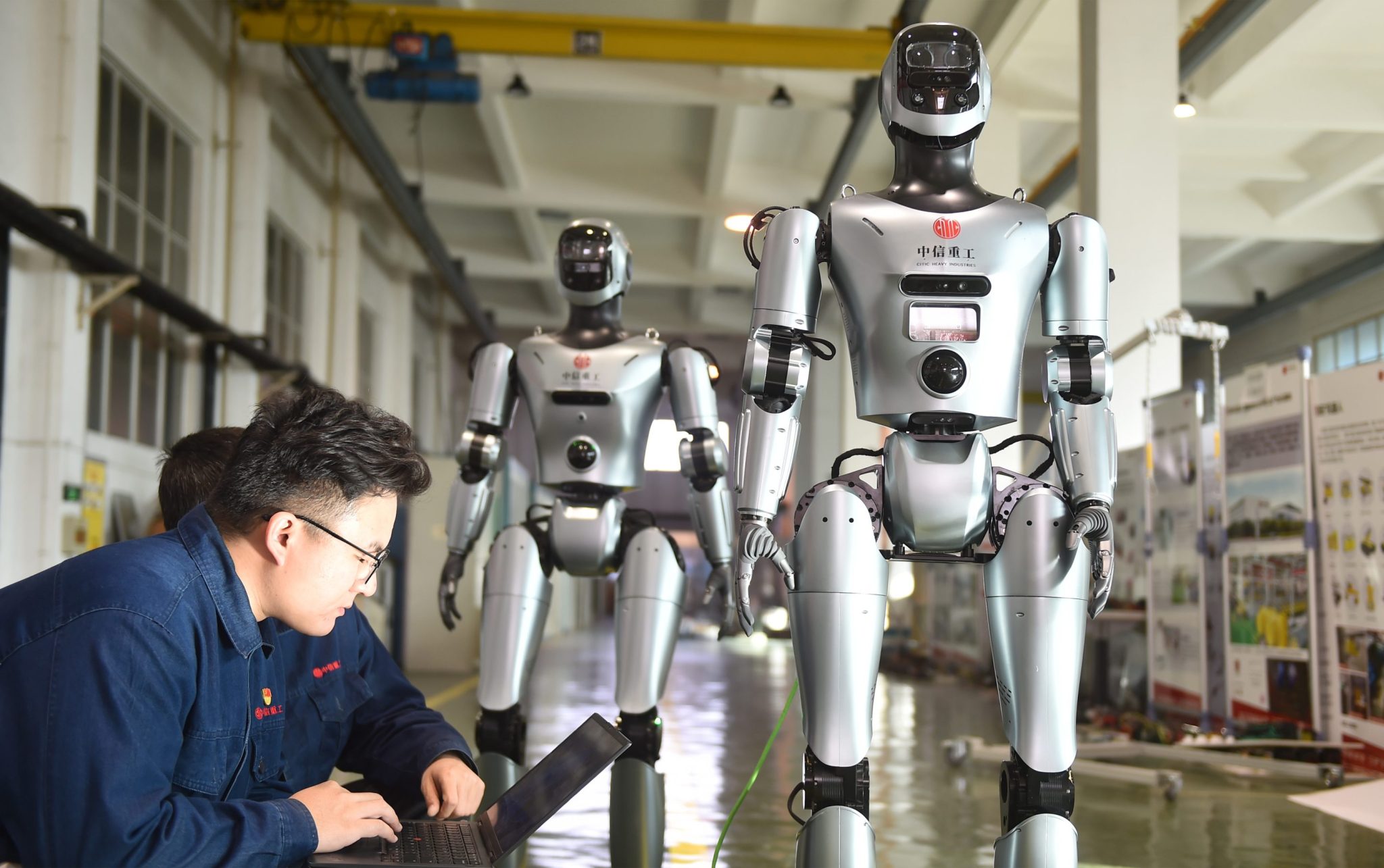
OpenAI Reorganizes Robotics Teams, Betting on General AI for Embodied Robots
OpenAI has restructured its approach to robotics by disbanding its stand-alone robotics team and moving its researchers onto other internal teams. The company characterized this reorganization as a commitment to robotics, rather than a retreat from the field.
Organizational Restructuring
The company confirmed the reorganization when questioned by Fortune. A company spokesperson stated that robotics remains a core component of OpenAI’s long-term vision. The reassignment involved moving the robotics research team to the company’s main research team, reporting to Chief Research Officer Mark Chen. Concurrently, the applied robotics and hardware teams were reassigned to the company’s larger Applied organization, which reports to OpenAI President Greg Brockman.
Historical Context of OpenAI's Robotics Efforts
OpenAI had previously maintained a robotics team, but it was wound down in 2020. Co-founder Wojciech Zaremba cited limited robot data and favored a more efficient path toward artificial general intelligence (AGI)—the human-like AI goal since the company's founding—through other methods. This involved becoming increasingly devoted to training ultra-large language models on vast datasets of human-written text, which eventually led to the breakthrough product ChatGPT in late 2022.
Recent Developments and Partnerships
OpenAI rebuilt a stand-alone robotics team in 2024 and announced a partnership with the startup Figure to develop AI models for humanoid robots. This partnership concluded in February 2025, when Figure announced plans to develop its own robot AI. Despite this, OpenAI reports that it is currently developing its own humanoid robot, with CEO Sam Altman targeting a first public demonstration in 2027.
The Shift to General-Purpose AI and Embodied AI
The reorganization reflects a growing trend across the AI industry: the belief that general-purpose models built for language, code, and vision can also be utilized for “embodied AI.” Embodied AI involves using AI models to control devices capable of acting in the physical world, such as robots, driverless cars, or drones. This approach aims to eliminate the need for separate robotics teams dedicated solely to building specialized AI models for robots as digital “brains.”
Researchers have observed surprising performance when connecting the general-purpose AI model GPT-6 Astra to robots, allowing the model to perform certain robotic tasks directly.
Guanya Shi, an assistant professor at Carnegie Mellon University’s Robotics Institute, interpreted the move as a signal that OpenAI views robotics “no longer as a special problem.” Instead, she suggested that the company likely sees robotics as a challenge that can be addressed as a downstream application of general intelligence, similar to how frontier AI models now power specialized tools for coding, legal, or financial work.
OpenAI confirmed this view in its response to Fortune. Initially, company researchers assumed the best path for robotics progress was building upon AI models like Sora, a video generation model that required an implicit understanding of how the physical world operates to create realistic videos. However, the company spokesperson noted that general-purpose frontier models, including GPT-6 Astra, have demonstrated that they can be directly applied to robotics. This discovery motivated the disbanding of the stand-alone robotics team and the reassignment of researchers to teams focused on more general AI models.
Business Pressures and Cost Management
The reorganization occurs amid pressure from within OpenAI to rein in operating costs and focus on a few core products. Last year, Altman instructed the company to abandon “side quests,” leading to the jettisoning of efforts, including Sora, to reallocate computing resources toward more core and potentially profitable endeavors.
The company is under pressure to manage heavy operating losses, which reportedly totaled $10.9 billion in the most recent quarter. This financial pressure is intensifying as OpenAI seeks to close a new funding round and prepares for a possible IPO in early 2027.
Challenging Traditional Robotics Assumptions
The philosophy that general AI models can be applied directly to controlling robots without needing specialized models for “spatial intelligence” challenges the assumptions of many robotics startups that have raised billions based on the premise that robots require their own brains.
Conversely, experts argue that specialized experience remains valuable. Russ Tedrake, an MIT professor and cofounder and CEO of Walden Robotics, asserts that robotics companies retain an advantage that AI labs lack: their robots gain work experience in real places, such as factory floors. This “deployment” experience and the data gathered help robots adapt to specific workplaces and tasks. Better foundational models can make this site-specific data more valuable, allowing robots to learn faster, Tedrake noted.
Performance Benchmarks and Future Needs
Experiments have tested the capacity of a general-purpose model to perform tasks without specialized training on robotic data. Researchers tested how an Astra-powered agent performed when given camera images, robot information, and a control interface to command the robot to take specific actions.
- An Nvidia study showed an Astra-powered agent achieved a 74.8% success rate on a simulated manipulation benchmark.
- This compares to 51.0% reported by the best specialized robotic models on the same leaderboard.
Guanya Shi further noted that advances in general models’ spatial and reasoning capabilities allow them to handle tasks previously requiring dedicated training. They can cope when a bottle is in a different position or the lighting changes, and they can reason about the sequence of a task or identify which step went wrong.
Despite the promise of general models, limitations remain. Large language models are powerful but slow and require hosting in the cloud, necessitating a constant network connection for the robot or device. Shi still sees a need for smaller, specialized models that can run on a robot’s onboard computer without needing a constant internet connection.
Pete Florence, cofounder of Generalist, a startup training general-purpose AI models for robots, stated that it remains unclear which existing model will dominate robotics in the long run. He suggested that there may be different starting points for how intelligence is grown.
The experience of former OpenAI robotics researchers, now reassigned to other teams, offers an answer to the question of how valuable robotics expertise remains as general-purpose models become more capable. This story, originally featured on Fortune.com, highlights the internal shift toward leveraging general intelligence for physical systems.
Source
Fortune
This story summarizes reporting from the publisher. Read the full piece at the source.
Written by
Hintsphere Staff
Writes for the Hintsphere desk.
