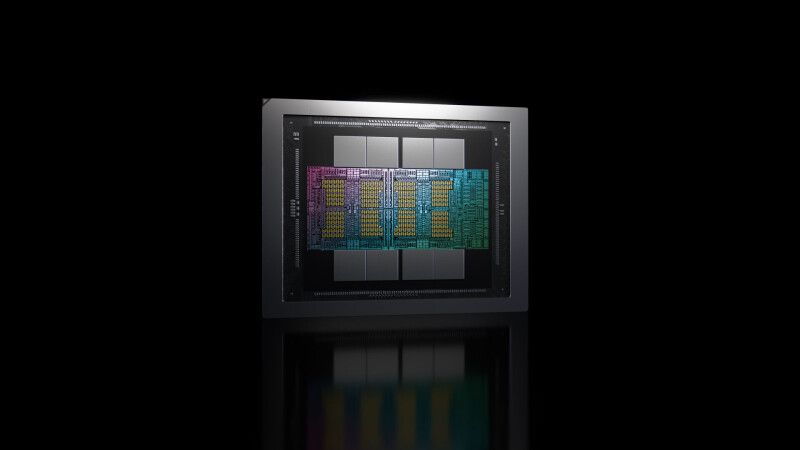
At Supercomputing 2026, Nvidia unveiled a new variant of its Rubin GPUs aimed at high performance computing (HPC).
The Rubin HPC promises more than 50,000 CUDA cores, which is nearly twice the number of cores found in the AI-focused version of the chip Nvidia unveiled earlier this year. This chip is scheduled to arrive sometime in 2028.
Dan Ernst, Nvidia’s senior director of supercomputing, stated that the new chip features a rebalanced architecture optimized for simulation, engineering, and high-performance analytics workloads common in the HPC and scientific computing communities.
Nvidia has a history of introducing specialized hardware; for instance, last year the company optimized its B300 accelerator for AI inferencing workloads. Ernst noted that Rubin HPC follows this pattern, emphasizing that Nvidia is building variants within the Rubin platform to focus on specific sub-domains of applications.
While details remain thin, Nvidia has not disclosed peak performance memory capacity or bandwidth. This focus on HPC suggests Nvidia still cares about the HPC community, contrasting with earlier moves, such as the launch of Blackwell Ultra (B300/GB300), which traded double-precision matrix acceleration for higher throughput at lower-precisions.
The Nvidia Rubin chip demonstrated mixed performance characteristics. While it achieved 15 petaFLOPS of AI compute at FP4, its performance for scientific applications was significantly lower, yielding only 1.3 teraFLOPS at FP64.
When compared to previous hardware, the chip showed performance deficits. At 33 teraFLOPS, it was slower at FP64 than the Blackwell GPUs it replaced, and also slower than Nvidia’s four-year-old Hopper accelerators.
Nvidia employed different strategies depending on the workload type. For sparse vector-heavy workloads, such as those measured by the High Performance Conjugate Gradients (HPCG) benchmark, Nvidia contended that a higher ratio of memory bandwidth to compute would provide meaningful performance gains.
Conversely, for dense matrix-heavy workloads, represented by benchmarks like High-Performance Linpack (HPL), Nvidia adopted FP64 emulation. This technique utilizes an algorithm derived from the Ozaki Scheme, which decomposes FP64 matrix operations into a string of INT8 operations. When run on Nvidia’s tensor cores, this process achieves higher-than-native performance, unlocking substantial performance gains for certain workloads.
Nvidia estimates that Rubin can generate up to 200 emulated FP64 matrix teraFLOPS. Nvidia assures that its HPC hardware is designed to offer native FP64 matrix performance, meaning customers will not have to rely entirely on emulation.
Assessing the new chip's vector performance is much easier.
The chip is projected to deliver at least 86 percent higher vector performance at double precision, based on calculations suggesting more than 50 thousand CUDA cores, closer to 53,248.
Regarding AMD’s offerings, the HPC-tuned version of its MI400-series GPUs was revealed in a blog post published late last week.
Specific hardware details include the Instinct MI430X, which boasts 432 GB of HBM4, 23 TB/s of memory bandwidth, and 288 teraFLOPS of peak double precision grunt.
AMD does not rely on FP64 emulation. Instead, the company utilized its modular chiplet architecture to create two distinct versions of its MI400-series accelerators: one optimized for AI and another designed to excel in HPC and scientific computing workloads.
AMD has shared predictions regarding how these chips will perform in several of the Top500’s headline benchmarks.
The House of Zen predicts that systems such as EuroHPC’s Alice Recoque and Oak Ridge National Laboratories’ upcoming Discovery supers would enjoy significant performance gains if they upgrade from earlier Instinct MI300A and MI250X-based offerings.
Source
The Register
This story summarizes reporting from the publisher. Read the full piece at the source.
Written by
Hintsphere Staff
Writes for the Hintsphere desk.
