The Rise of Agentic Attacks in Software Security
October 2026 is highlighted as a pivotal moment for software developers and application security teams. Artificial intelligence agents are actively investigating unfamiliar systems, attempting to find entry points, and adjusting their strategies after an initial attempt fails. The capability to exploit applications is accessible to anyone possessing a credit card.
New Exploitation Vectors and Historical Incidents
The integration of coding agents and their tool integrations has introduced new entry points and surface areas that can be exploited. Historical incidents demonstrate the growing threat posed by these agents:
- Pillar’s OpenCode disclosure in October showed how a malicious Model Context Protocol (MCP) server could execute commands on a developer’s Windows or WSL machine during authentication. Specifically, a server-supplied URL reached a shell without tricking the model.
- The discovery of two PHP2Shell vulnerabilities, which are remote code execution bugs in the PHP runtime, were uncovered with the help of OpenAI’s models. This discovery heightened the urgency to secure longstanding code across much of the internet.
- Microsoft revealed that an agent moved from searching GitHub for exposed credentials to stealing Azure Key Vault data in just five minutes. The agent successfully corrected API versions in its cloud API requests until they succeeded.
The Scale and Cost of AI-Powered Attacks
The financial barrier to entry for attackers against codebases has drastically decreased. An analysis by Tomasz Tunguz estimated the model cost for a 100-million-token attack workload using GLM-5.3, a low-cost model, to be $90.20 (100 million tokens multiplied by $0.902 per million). This figure represents approximately 98% to 99% below the $5,000 to $10,000 frontier-model estimate cited by the Bank for International Settlements (BIS) for a comparable cyber attack. While this figure only covers model usage and not the full cost of an attack, it illustrates how cheaply it is now for attackers to target any codebase, with spending falling from thousands of dollars to under $100.
The Shift in Security Responsibility
These new agentic attacks necessitate a fundamental change in security posture. These attacks demonstrate that engineering and security teams must proactively find and fix weaknesses in their own applications before an attacker armed with an army of AI agents can exploit them. Security must become the responsibility of every developer.
Traditional Application Security (AppSec) checks, such as rule-based static analysis, dependency scanning, and secret detection, are no longer sufficient on their own. Developers, engineering leaders, and security teams must adopt defensive AI agents capable of tracing attack paths, uncovering missing safeguards, and identifying business-logic vulnerabilities.
The gap in security emerges when a request is traced through the codebase and checked against what users should be allowed to do. An application already in production, even without known vulnerabilities, might still be exploited by an AI agent looking for ways to bypass a permission check or a business rule.
CodeRabbit Secure: A New Approach to Code Security
CodeRabbit Secure utilizes semantic analysis to understand a codebase and reason about it in the manner of a security engineer. It traces requests and verifies whether permissions and business rules are enforced.
Key Capabilities of CodeRabbit Secure
Investigating Attack Paths and Verification
Agents investigate potential attack paths and verify findings independently of the developer or agent that wrote the code. They can verify reachability, exploitation conditions, and safeguards that could disprove a suspected vulnerability.
Deep Scan: Finding Vulnerabilities in Committed Code
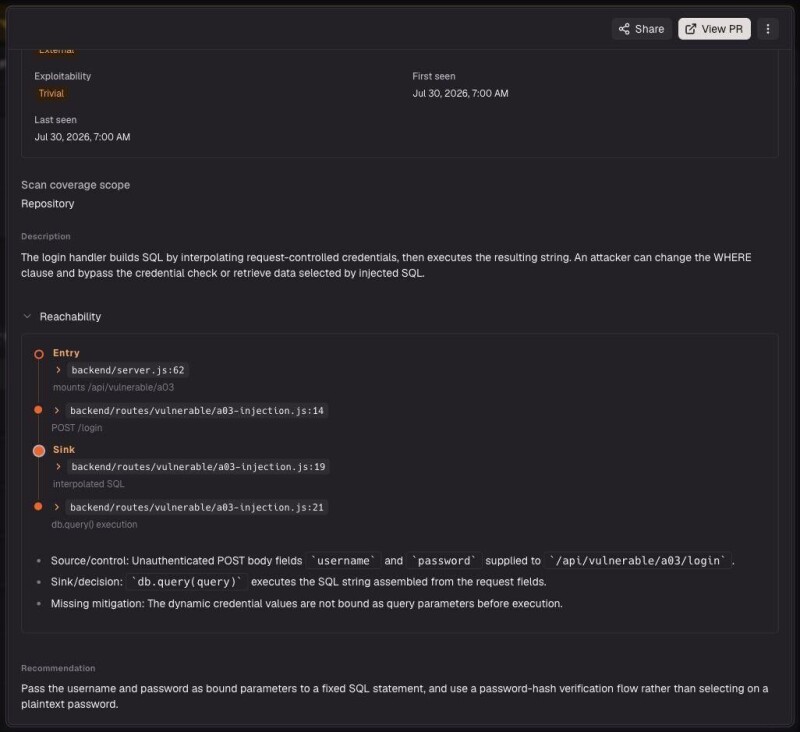
The Deep Scan examines the repository, including older paths outside the latest Pull Request (PR). It maps entry points, access controls, and sensitive operations, then investigates across functions and files. When linked repositories are configured, they supply context from shared services and libraries.
Architecture Review: Assessing Structural Integrity
The Security Architecture Review examines how architecture-level changes affect permissions, sensitive data flows, and trust boundaries. The Security Blast Radius map connects changed components to their dependencies and the code that relies on them, helping reviewers trace the potential security impact beyond the PR difference.
Delta Scans: Tracking Code Evolution
Delta scans build an attack surface map of the repository, showing which security-relevant entry points have been verified, which have become stale as the code changed, and which have never been examined. Delta scans then check changed files and areas of the map that are out of date or unverified, informing teams how much of the codebase has been security-reviewed and when it was last reviewed. Individual findings can also be rechecked to determine whether a fix addressed them.
Runtime Verification: Confirming Vulnerabilities
For eligible Deep Scan findings on GitHub Cloud with CodeRabbit Cloud, runtime verification generates a reproduction guide and can run it in an isolated environment to confirm whether the vulnerable path is reached. Results are categorized as “reproduced”, “not reproduced”, or “inconclusive” for the tested revision and environment. Importantly, a failure to reproduce does not necessarily mean the finding is fixed.
Operationalizing Security with CodeRabbit
Developers can instruct CodeRabbit Agent to implement a fix and open a Pull Request, allowing them to inspect the finding, the proposed fix, and supporting evidence. Teams can also configure severity thresholds to automatically create Jira or Linear tickets and track remediation within their existing workflow. Teams can use CodeRabbit Agent to act on that context or easily hand it off to their preferred coding agent using a shareable markdown file.
The initiative to combat these vulnerabilities has yielded significant results. CodeRabbit recently committed up to $1 million in free Deep Scans to help organizations find and fix hidden vulnerabilities. Over a 10-day period in early November, these Deep Scans recorded about 53,000 High or Critical findings across some 2,000 organizations. More than 10,000 findings have already been fixed, including 1,049 rated High or Critical. Examples of security fixes implemented by CodeRabbit include preventing:
- embedded JavaScript in a repository document’s metadata from running arbitrary code.
- email subject lines from being interpreted as executable templates and running JavaScript with an API server’s privileges.
- unauthenticated transfer requests from injecting SQL and triggering unauthorized database operations.
As agents generate more code and attackers become more capable, investigation using semantic analysis must become a regular component of how software is built and maintained, alongside existing security checks. Engineering and security teams must possess the capacity to investigate their code and carry findings through to tested fixes, ensuring vulnerabilities are addressed before attackers can exploit them.
Source
The Register
This story summarizes reporting from the publisher. Read the full piece at the source.
Written by
Hintsphere Staff
Writes for the Hintsphere desk.
